
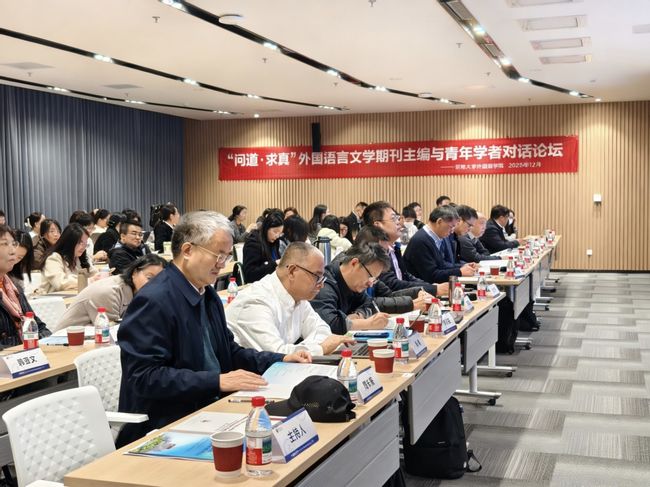
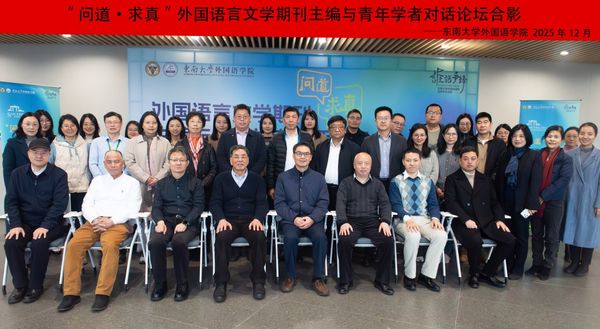
On December 20, the School of Foreign Languages at Southeast University successfully convened the “Seeking the Dao, Pursuing the Truth” Forum, facilitating a high-level dialogue between editors-in-chief of leading foreign language and literature journals and young scholars. The forum, held at the New Liberal Arts Building on the Jiulonghu Campus, focused on research trends, paradigm innovation, and scholarly writing in the digital intelligence era.
The event brought together editors from over ten prestigious journals, including Foreign Language Teaching and Research, Chinese Translators Journal, and Shanghai Journal of Translators. Deans, faculty members, and student representatives attended the forum. The opening ceremony was presided over by Dr. Ma Xingcheng, Assistant Dean.
In his opening address, Dean Liu Kehua extended a warm welcome to the experts. He emphasized the forum's significance in promoting disciplinary innovation amid deepening AI integration and interdisciplinary development. Dean Liu briefly outlined the School's recent progress in disciplinary development, faculty optimization, and academic research, reiterating its commitment to supporting young scholars and fostering open, integrated academic exchange.
During the keynote sessions, the editors shared insights aligned with their journals' scope and the latest academic frontiers. Discussions centered on several key themes:
Theoretical and Discourse System Building: Experts stressed the need to enhance theoretical awareness, address China's realities, and construct disciplinary and discourse systems with local characteristics and global communicative power.
Methodological Innovation: The transformative potential of Digital Humanities as a new liberal arts paradigm was highlighted, alongside the continued relevance of corpus linguistics. Editors urged scholars to embrace technological tools while maintaining disciplinary focus and critical thinking.
Research Integrity and Writing: Practical advice was offered on topic selection, logical structuring, and project proposal development. The importance of problem-oriented research, conceptual innovation, and adherence to academic integrity—especially regarding AI tool usage—was underscored.
A dedicated “Dialogue between Young Scholars and Editors” session was held across three parallel panels. Over thirty young faculty and doctoral students received targeted feedback on their research proposals or draft papers. Editors provided constructive guidance on sharpening research questions and refining academic expression. The sessions were dynamic and productive, embodying the forum's spirit of “seeking the dao and pursuing the truth.”
This forward-looking forum provided profound inspiration for faculty and students alike, clarifying development paths and innovative directions for foreign language studies in the digital age. The School will integrate the insights gained, continuing to explore with the spirit of “seeking the dao” and research with the attitude of “pursuing the truth.” It remains committed to strengthening disciplinary development and talent cultivation, contributing to building an influential academic platform and advancing the foreign language discipline system with Chinese characteristics.
Text: Cui Yixiao, Zhang Tingting
Photos: Wang Yining
Translated: Li Yixiao, Zhang Tingting
Proofreading: Guo Qing