

On April 8, the workshop Translation and Communication in the AI Era, an academic event under the flagship program “Language Masters Forum” of the School of Foreign Languages at Southeast University, was successfully held in Conference Room 821. The workshop featured keynote presentations by Professor Li Xiangping from Shandong University and Professor Fu Jingmin, Editor-in-Chief of Shanghai Journal of Translators. Dean Liu Kehua, young faculty members, and representatives of master's and doctoral students from the School attended the event, which was chaired by Vice Dean Cheng Si.
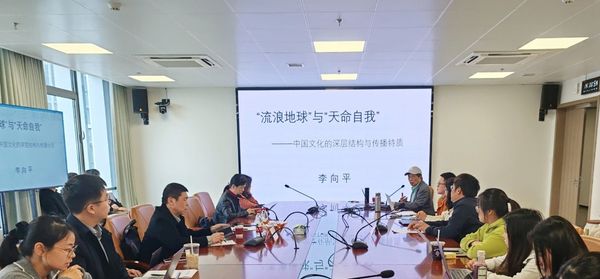
Dean Liu Kehua warmly welcomed the two experts and encouraged postgraduate students and young teachers to make full use of the opportunity to consult the experts and engage in in-depth discussions. Professor Li Xiangping delivered a speech entitled “The Wandering Earth and the 'Destined Self': The Deep Structure and Communication Characteristics of Chinese Culture”. He pointed out that Chinese culture, rooted in agricultural civilization, has formed deep structures such as “family-state isomorphism”, “harmony between man and nature”, and “practical rationality”, and its communication is characterized by high-context and flexible diffusion. In the short-video era, cultural export is shifting from a “preaching model” to a “narrative model”. Successful cases such as Black Myth: Wukong show that the combination of individual narratives, visual spectacles, and technological empowerment can transform the deep logic of “cherishing one's own beauty” into a global public good of “sharing beauty together”. He emphasized that the global outreach of Chinese culture needs to transcend the constraints of high and low contexts, shift from “traffic-oriented thinking” to “brand-oriented thinking”, and achieve effective cultural reach through civilian identity and commercial logic.
Professor Fu Jingmin delivered an in-depth analysis on “What is Translation and What is Translation for in the Artificial Intelligence Era”. He sorted out the multiple definitions of translation from “language transfer” to “cross-cultural communication” and then to “rewriting and resistance”, pointing out that the value of translation has been questioned in the AI era. However, translation is not only instrumental but also speculative, embodied, and generative. He proposed that AI translation is also a form of translation, yet the functions of human translation such as power representation, identity construction, and knowledge dissemination can hardly be fully replaced. Faced with technological impact, translation studies need to reconstruct paradigms, shifting from a service-oriented perspective to a greater focus on the multiple meanings of translation as a method, an event, and a way of being.
In the expert dialogue and interactive session, the two professors engaged in heated discussions with teachers and students on topics including “whether AI translation will replace human translation” and “how high-context cultures can be communicated effectively on low-context platforms”. Participants remarked that the workshop integrated cutting-edge perspectives from translation studies and cultural communication, providing profound insights into cross-cultural practices in the AI era.
Text: Wang Zhuowen
Photos: Wang Yining
Translated: Li Yixiao, Zhang Tingting
Proofreading: Ke Ying, Frank